Automatisation des réponses MedTech : guide en 5 étapes
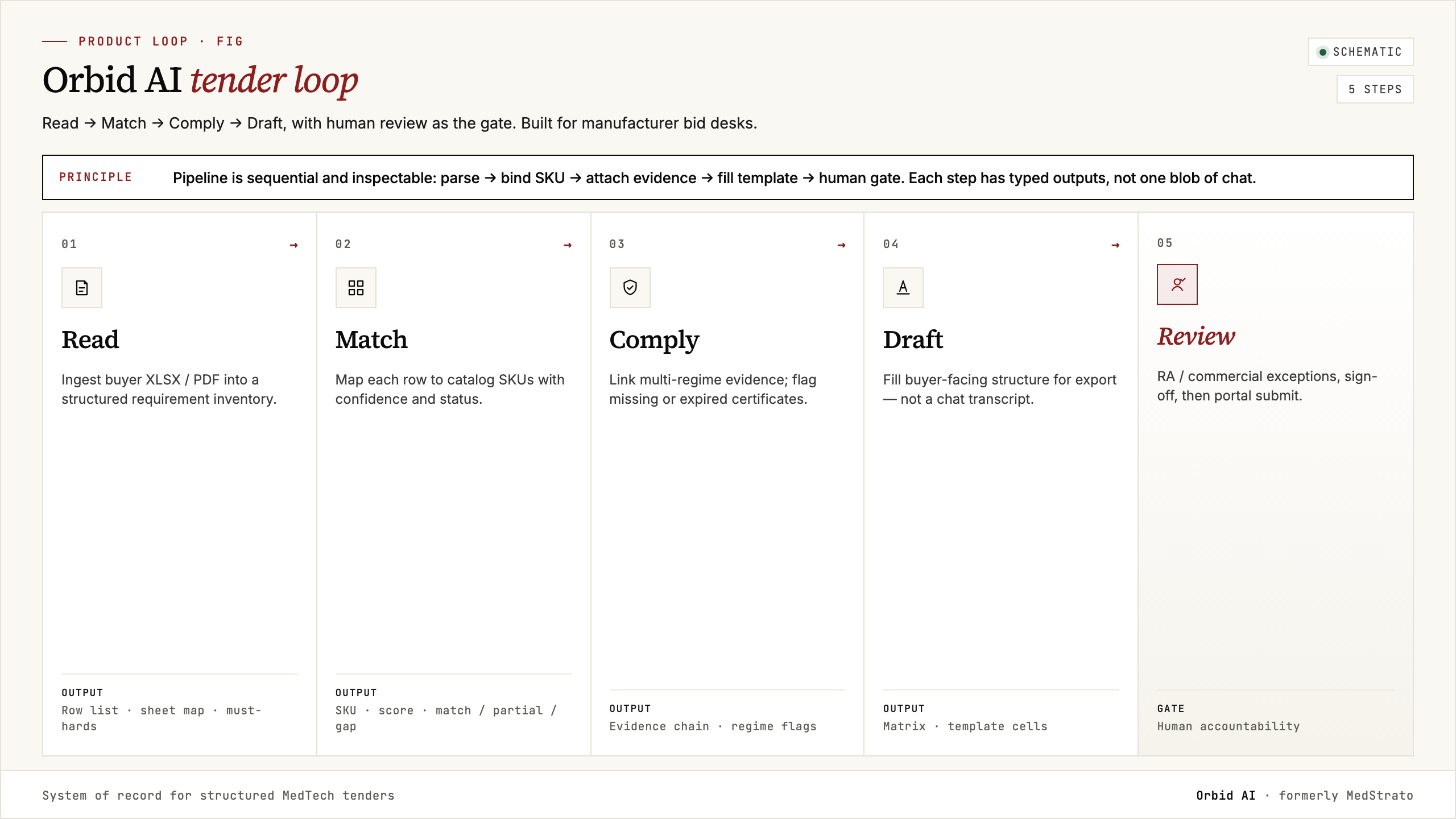
Réponse d’abord : Guide opérationnel en cinq étapes pour l’automatisation de réponse MedTech côté fabricant : extraire les exigences, matcher les specs, vérifier la conformité, assembler les preuves, exporter le modèle acheteur. L’agent IA natif—Orbid AI (ex-MedStrato)—exécute la boucle mécanique ; les responsables d’appel d’offres et la RA gardent stratégie et signature. Définition produit : pilier automatisation MedTech. Démo : /book · Produit : orbid.dev.
Si l’équipe prépare encore à la main—copier des specs dans des tableaux, chasser les IFU, cocher la conformité ligne à ligne—le temps est souvent d’un ordre de grandeur au-dessus d’un bureau assisté par agent en 2026.
Ce qu’est l’automatisation de réponse
L’automatisation de réponse remplace les étapes manuelles fragiles par des workflows IA. L’enjeu n’est pas le copy marketing, mais le match de specs, les contrôles de conformité et l’assemblage d’évidence à vitesse machine—les humains gardent le go/no-go.
Pourquoi 2026 compte encore
Cycles hôpitaux plus courts et packages réglementaires plus lourds laissent les bureaux 100 % manuels derrière. L’automatisation compresse la ressaisie et expose plus tôt les trous de certificats—elle ne rend pas une soumission « zéro erreur de conformité mathématique ». RA et bid owners doivent revoir.
- Extraction des exigences — PDF/Excel/Word → lignes structurées
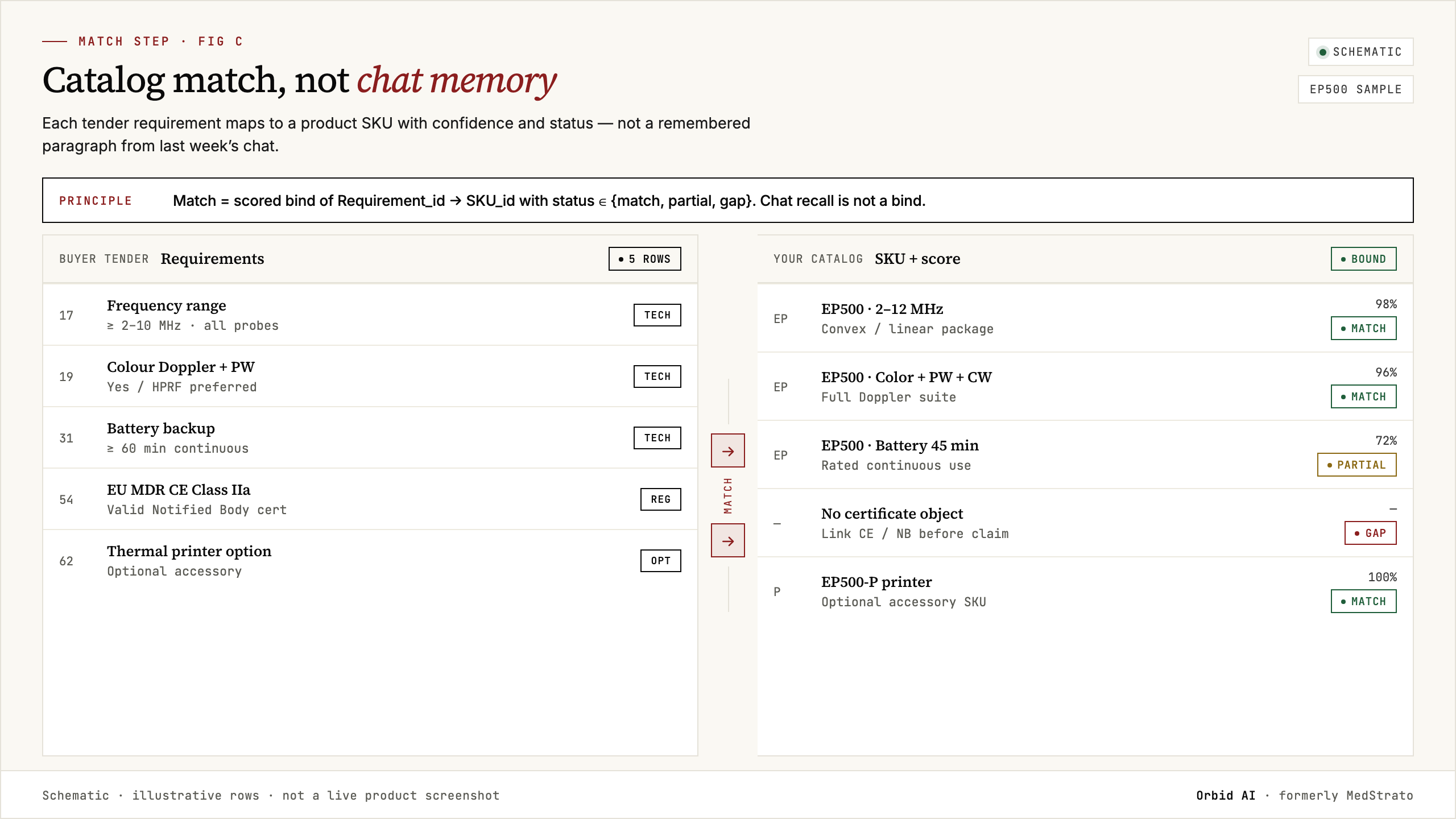
- Match de specs — mapping catalogue produit avec confiance
- Contrôles conformité — statut FDA/CE, etc.
- Collecte d’évidence — specs, certificats, rapports de tests
- Export — alignement modèle acheteur
Manuel vs assisté par agent
| Phase | Manuel | Assisté agent |
|---|---|---|
| Extraction | Heures | Minutes ou moins |
| Match de specs | Beaucoup d’heures | Souvent dizaines de secondes si catalogue propre* |
| Conformité / évidence | Heures | Minutes + revue RA |
| Export | Heures | Brouillon auto |
| Revue stratégique humaine | Heures | Heures (conservée) |
| Total | Plusieurs jours | Dominé par les heures de revue |
*Benchmark interne indicatif—validez avec vos appels d’offres.
Pourquoi les outils RFP génériques échouent pour les devices
- Pas de conscience réglementaire ni de précision au niveau specs
- Pas de chaîne d’évidence
- Les exigences multi-régimes ne se résolvent pas par bibliothèque de mots-clés
Que vérifier sur un agent de réponse
- Définition d’accuracy et bake-off sur appels d’offres réels
- Couverture réglementaire
- Parsing documents sales / multi-feuilles
- Intégration catalogue et bibliothèque documentaire
- Piste d’audit
- Sécurité et certifications de conformité
Feuille de route de déploiement
- Semaines 1–2 : pilote sur historiques
- Semaines 3–4 : brancher catalogue et doc library
- Semaines 5–8 : go-live en vérification parallèle
- À partir du mois 3 : production ; humains sur edge cases et portes RA
Mesurer le succès
| Indicateur | Baseline manuelle | Direction automatisation |
|---|---|---|
| Cycle de réponse | Semaines | Jours dominés par la revue |
| Trous d’évidence avant soumission | Tardifs | Plus tôt, ligne à ligne |
| Volume mensuel poursuivable | Plafond de capacité | Plus haut à headcount constant |
| Confiance RA dans la piste | Archéologie tableur | Liens claim → source |
Conclusion
En 2026, l’automatisation de réponse est le socle d’un bureau device compétitif. Validez sur vos propres appels d’offres · Fonctionnalités · orbid.dev · pilier automatisation.