MedTech Tender Response Automation für Bid-Desks [2026]
Antwort zuerst: MedTech Tender Response Automation ist ein nativer AI-Agent-Job für Hersteller-/Distributoren-Bid-Desks: Buyer-Pack lesen, Katalog-SKUs matchen, Multi-Regime-Evidenz anhängen (FDA, EU MDR/IVDR, MHRA und vergleichbare), Buyer-Template exportieren—Menschen behalten Go/No-Go und RA-Sign-off. Es ist kein Krankenhaus-Procurement-System, keine horizontale RFP Content Library und kein Chatbot, der Marketing-Copy in Tabellen klebt. Orbid AI (ehemals MedStrato) ist der Agent von Galaxias Inc. für diese Schleife.
Demo buchen · orbid.dev · 5-Schritte-Guide · Software-Vergleich.
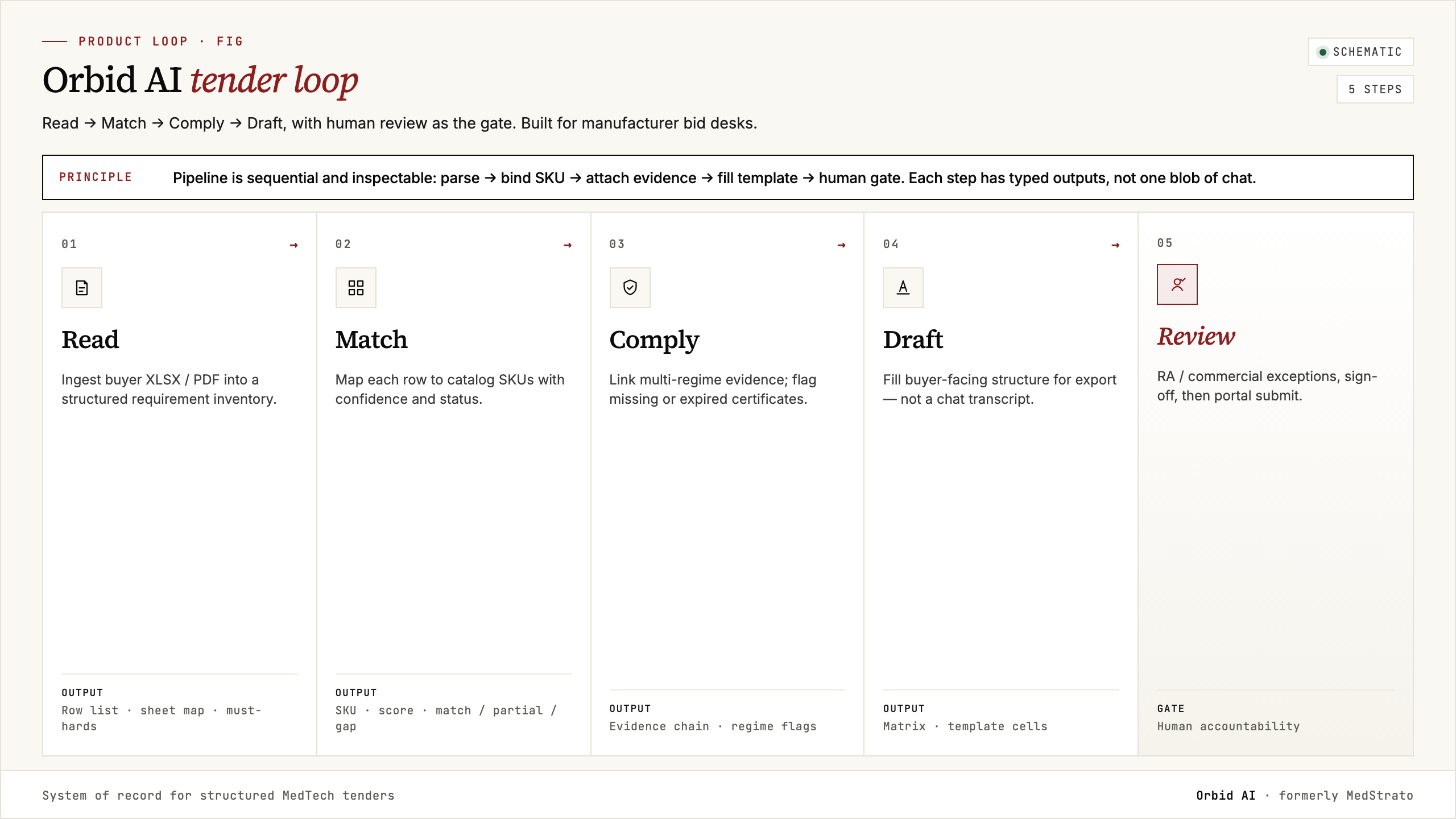
„Automation“ im Hersteller-Bid-Desk
- Read — XLSX / PDF / Multi-Sheet
- Match — SKU full/partial/gap + Confidence
- Compliance — Regime-Evidenz; abgelaufen und Scope-Gaps
- Draft/Export — Buyer-Template-Spalten
- Human Gate — Strategie und RA-Sign-off
Diese Schleife ist die Produktverantwortung von Orbid AI.
Vier oft vermischte „Tender Software“-Jobs
- Horizontales RFP-SaaS (Loopio-artig)
- MedTech Bid Collaboration (TenderEyes-artig)
- Life-Sciences-Intel + Multi-Agent-Suite (Cube-RM-artig)
- Technical-Pack Response Agent (Zeilen-Match + Multi-Regime-Evidenz + Export)
Orbid AI bedient Job 4.
Manuell vs Agent-gestützt
| Phase | Manuell | Agent-gestützt |
|---|---|---|
| Requirement Extraction | Stunden | Minuten oder weniger |
| Spec Matching | Viele Stunden | Zehn-Sekunden-Bereich* |
| Compliance/Evidence | Stunden | Minuten + RA |
| Export | Stunden | Auto-Draft |
| Strategisches Review | Stunden | Stunden (bleibt) |
*Interner Richt-Benchmark—bitte validieren.
Warum generische AI / RFP-Libraries scheitern
- Keywords durchbrechen Spec-Semantik nicht
- Evidenz ist nicht auditierbar
- Multi-Regime ist kein Single-Boilerplate
- Buyer-Templates bestrafen Umformatierung
Head-to-head: vs Loopio · vs Cube · Gesamtvergleich.
Workflow und KPIs
As-is anbinden, autoritativer Katalog, Compliance vor Commercial, Buyer-Format-Export, Audit Trail. KPIs: Review-Stunden, First-Pass Compliance Coverage, Clarification Rounds, Bid-Kapazität, RA-Vertrauen.
Tracking vs Response
Tender finden ≠ Matrix füllen. Siehe Tracking Software.
Demo · orbid.dev · Best-of 2026.