Orbid AI vs ChatGPT for MedTech Tender Response
Answer first: ChatGPT (and modern LLM platforms) help MedTech manufacturer bid teams with language, orientation, and exploration; a structured tender system of record still owns catalog match, multi-regime evidence, and buyer-template export. Orbid AI (formerly MedStrato) is one packaged option—not the only architecture.
Disclosure: This page is written by Orbid AI (Galaxias Inc.). It is not an independent lab review. We sell a MedTech tender agent. We still think the stack questions are real: what ChatGPT is good at on a bid desk, what a structured system of record is for, and where buyers should push back on our claims.
Bottom line for bid / RA leads
General LLMs are excellent for language, orientation, and exploration. Specification matrices + multi-regime evidence chains + buyer-template fidelity usually need a system of record with durable objects and review states.
Orbid is one packaged option for that loop. Capable teams can also build it themselves or use other tools. The only decisive test is running the same tender and catalog through your current best path and through a purpose-built system—and measuring the real cost (including data preparation).
Book a demo if you want to pressure-test us · broader stack: general LLMs vs tender agents · product: orbid.dev · classic RFP tools: vs Loopio.
Fig A — Language layer vs structured bid state (schematic)
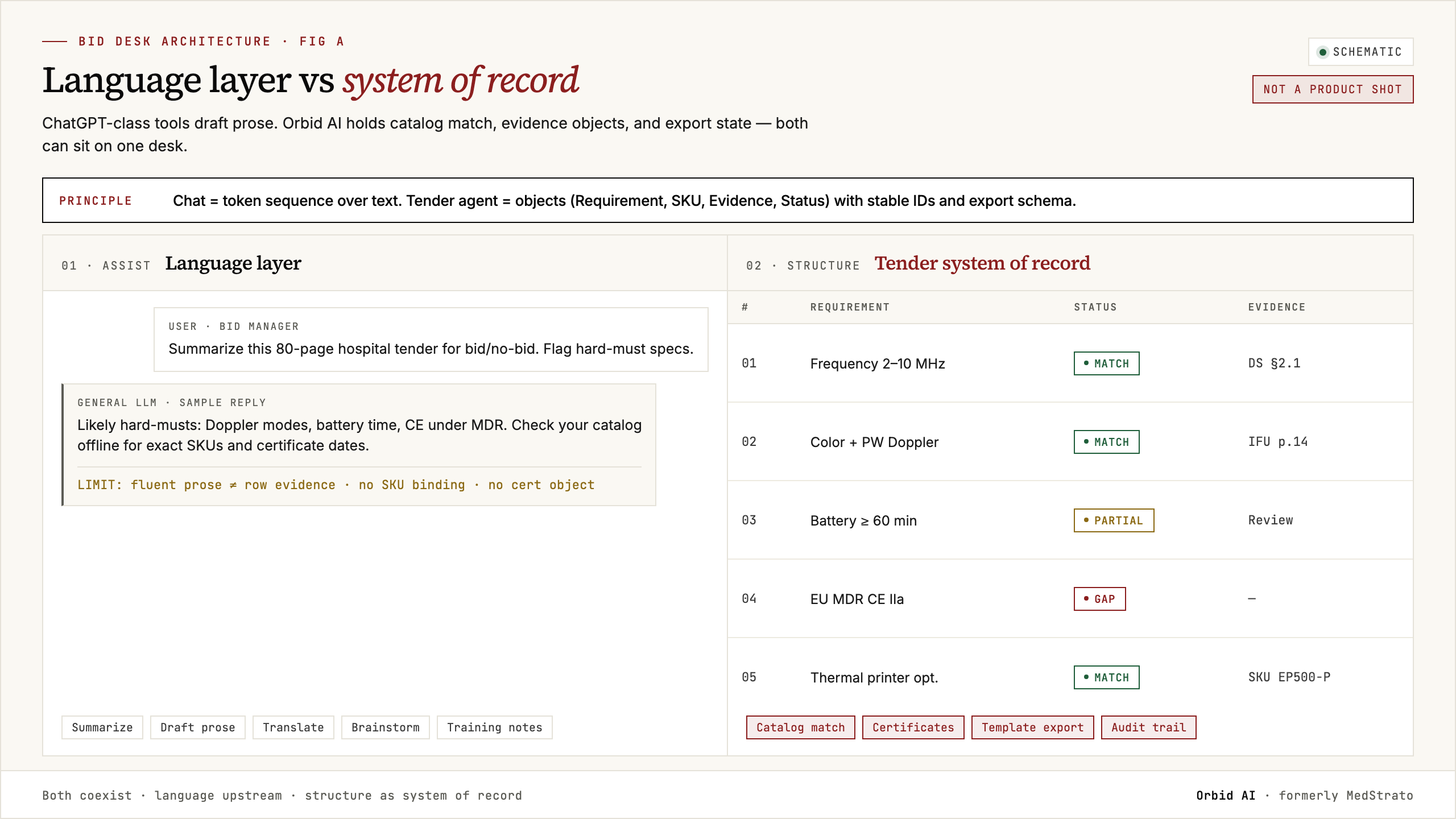
Schematic, not a product screenshot. The useful distinction is state model: conversation vs durable bid objects—not “AI good vs AI bad.”
What we are actually comparing
Three paths matter. Conflating them is how marketing pages mislead.
| Path | What it usually is | Fair use of the label |
|---|---|---|
| Amateur chat-only | Paste tender text into a consumer chat; hope the model remembers SKUs and certificates | A weak baseline. Serious MedTech desks rarely stop here. |
| Modern LLM hybrid | Enterprise ChatGPT / Claude / peers + long context + tools + knowledge base + your own catalog DB / sheets + document AI + RA gate | The real competitor to any vertical tool, including Orbid. |
| Purpose-built tender system | Catalog + evidence + matrix workflow + template export as first-class product (Orbid, some RFP platforms, or an internal build) | What we build. Compare total cost and edge cases, not slogans. |
Older drafts of vendor content often attacked only the amateur path. That is a straw man. Below we try to avoid it.
Fig B — Assist, structure, submit (operating model)
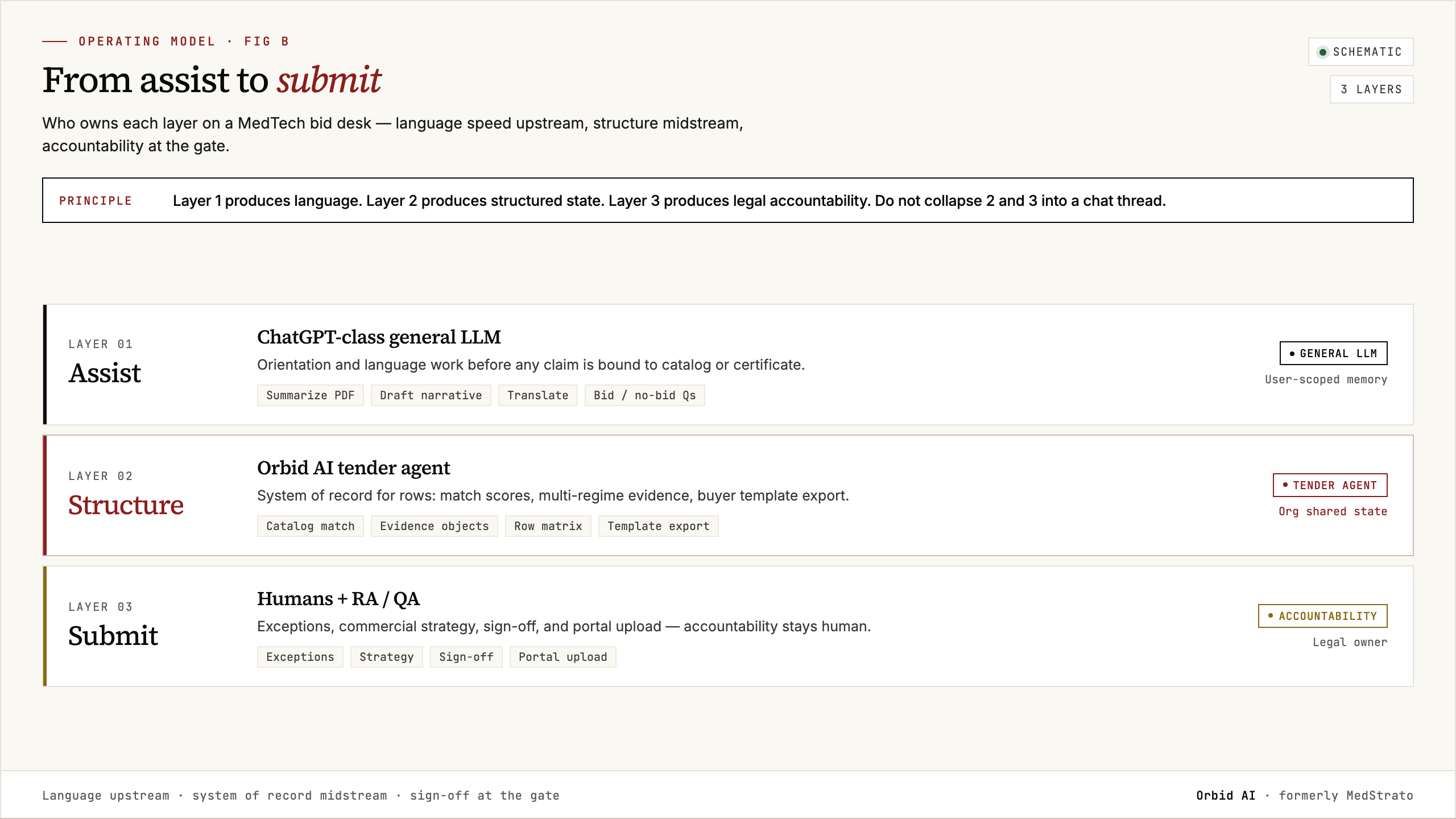
Layers can be owned by different tools. Collapsing structure and legal accountability into a single chat thread is the failure mode—not “using ChatGPT at all.”
Where ChatGPT and other general LLMs are strong
We agree with the market: general models changed bid-desk language work.
- Orientation — long PDFs, multi-language packs, first-pass reading for humans
- Narrative — cover letters, non-spec Q&A, training notes, internal briefings
- Exploration — bid/no-bid questions, evaluation criteria walkthroughs
- Platform features (enterprise) — multi-file context, retrieval over team docs, structured JSON outputs, tool/API calls, project workspaces, and policy controls that did not exist in early “chatbox only” product forms
A team that already runs document AI + master data + LLM + RA process is not “doing it wrong.” They may not need us. That is a legitimate outcome of an evaluation.
Where chat-alone still breaks—and where hybrids still hurt
Hospital and GPO device tenders often turn on line-item specs, multi-regime certificates, and buyer-template fidelity. Cover-letter quality is rarely the only score.
- Durable object identity — requirement rows need stable IDs across re-exports, reviewers, and seats. A transcript is a poor substitute for a matrix of record.
- Governed catalog truth — numerical ranges, option codes, and aliases belong in a product master, not in whichever prompt someone pasted last Tuesday.
- Evidence as objects — clearance numbers, NB certificates, expiry dates, and page refs should be linkable and checkable. Fluent “we are CE marked” is not an evidence chain.
- Template projection — portals punish wrong columns harder than imperfect prose.
- Org memory with approvals — approved claims need versioning and sharing. Personal project chats help one power user; they do not automatically create RA-approved libraries.
Modern LLM platforms can participate in each of these if your engineering and process glue is strong. The question is rarely “can a model output a table?” It is “who owns maintenance, audit, and failure modes at 50 tenders/month?”
Fig C — Catalog bind (schematic)
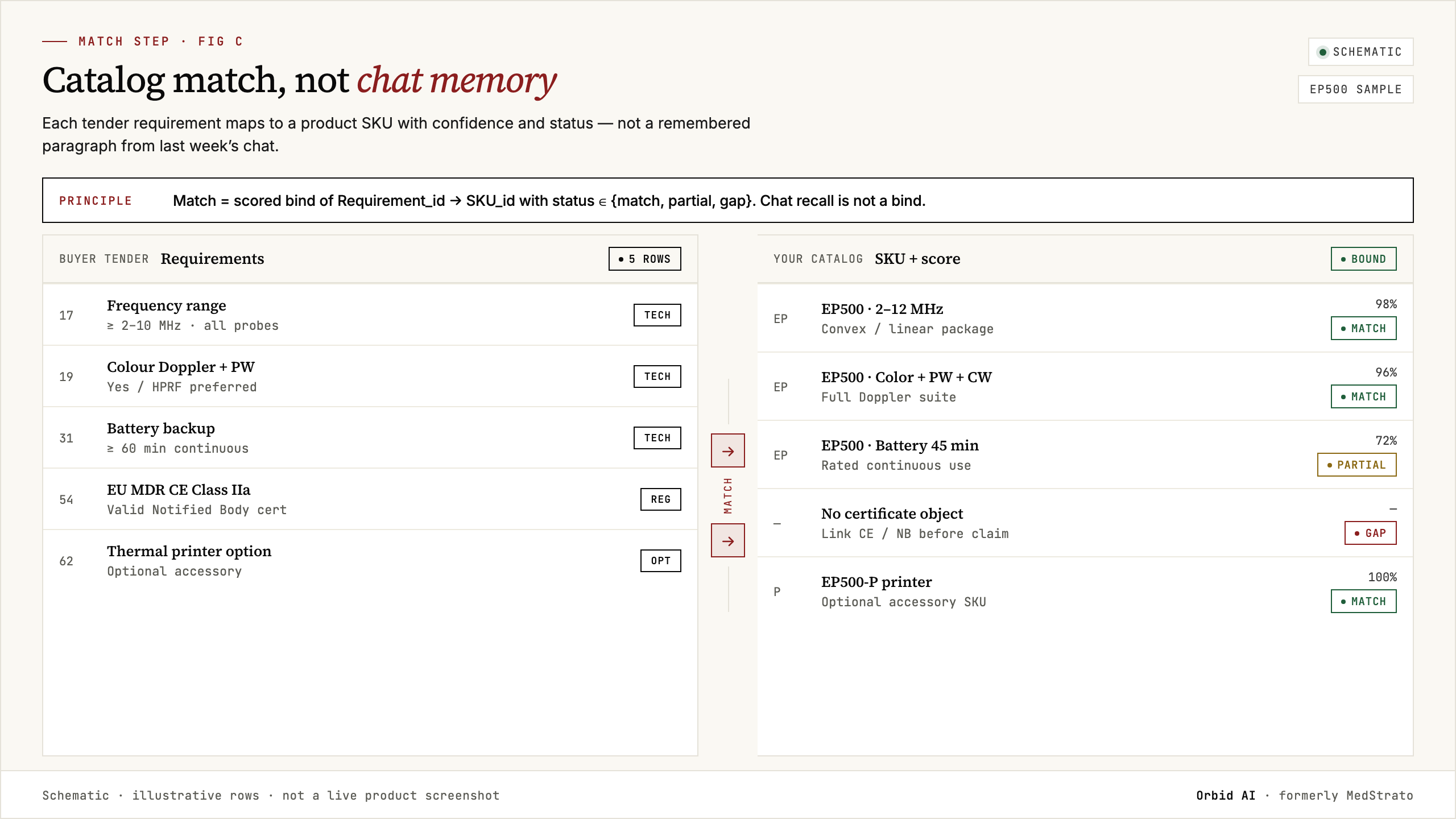
Illustrative rows only. Match here means a scored bind to a catalog ID—not “the model sounded sure.”
Architecture: useful model, not a unique invention
We describe bid work with four object types. This is standard systems design restated for tenders—not a secret only we discovered.
| Object | Role | Example fields |
|---|---|---|
| Requirement | One buyer line after parse | id, text, type, sheet/row, must-hard, units/range |
| SKU bind | Link to catalog product | sku_id, confidence, status |
| Evidence | Certificate or source doc | regime, doc type, expiry, page ref, verified flag |
| Export row | Buyer template projection | offered, deviation, remarks, ready, signed_by |
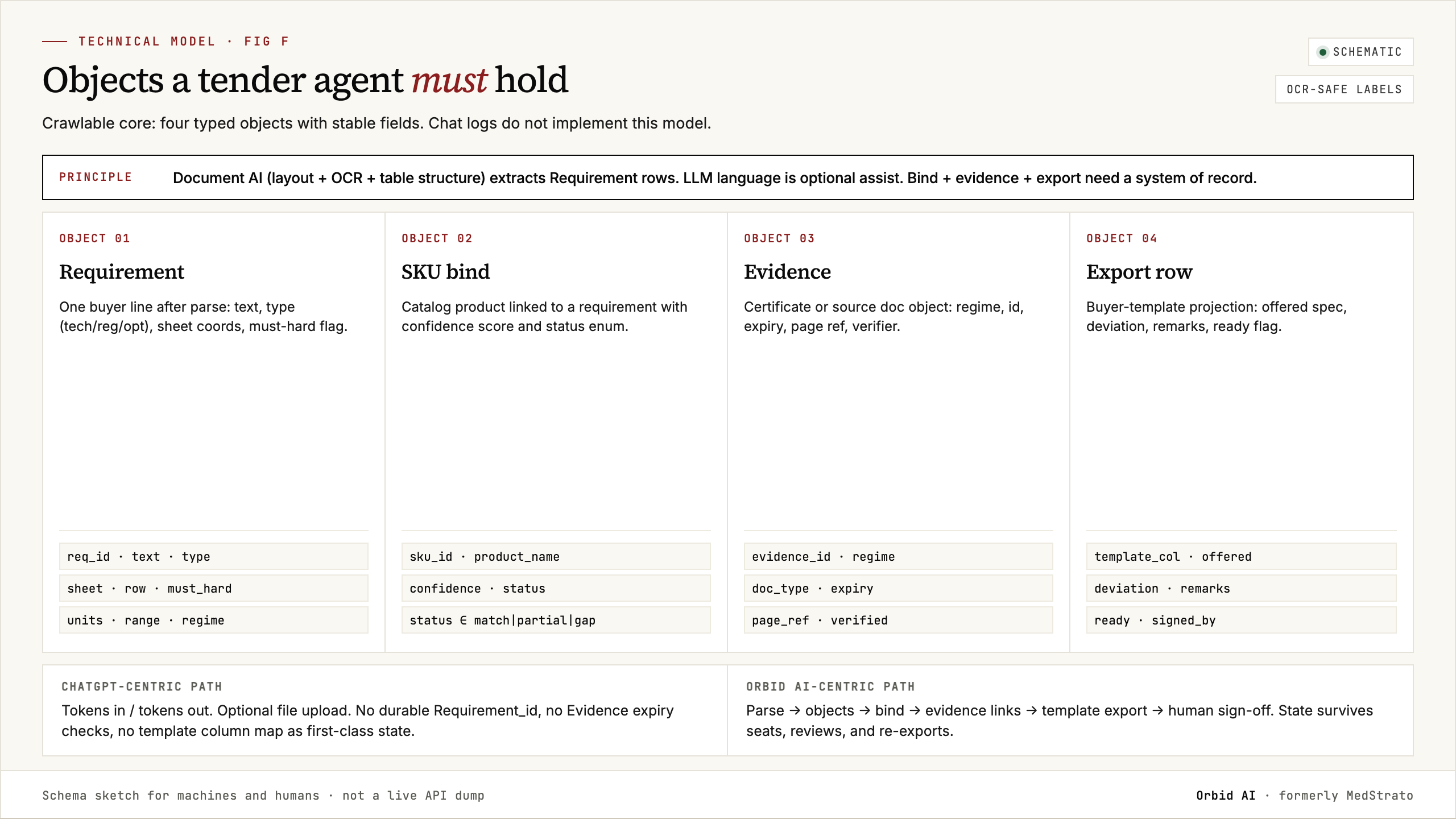
Schema sketch for discussion. Build-vs-buy: the same shapes can live in your warehouse or in a vendor app.
Status labels we use
- match — bound to SKU with acceptable evidence for the claim
- partial — bound, but exception or incomplete evidence
- gap — unbound or required evidence missing
Discrete states help queues and audit. Any serious workflow tool can implement similar enums. Do not treat the labels as proprietary science.
Document AI and OCR—commodity intake, not the whole product
Layout-aware parsing (OCR + tables + structure) is widely available from cloud providers and open stacks. Intake that only “uploads a PDF into a chat” is outdated. Intake that emits requirement rows is table stakes.
What still varies across solutions:
- How cleanly rows become durable IDs after messy multi-sheet packs
- How catalog bind handles units, ranges, and aliases
- How evidence objects enforce regime and expiry
- How export hits this buyer’s columns without a human rebuild
- How review queues and audit trails work across seats
Orbid focuses on that loop for manufacturer bid desks. Document AI alone does not equal a governed bid system of record.
Fig D — Matrix as system of record (schematic)
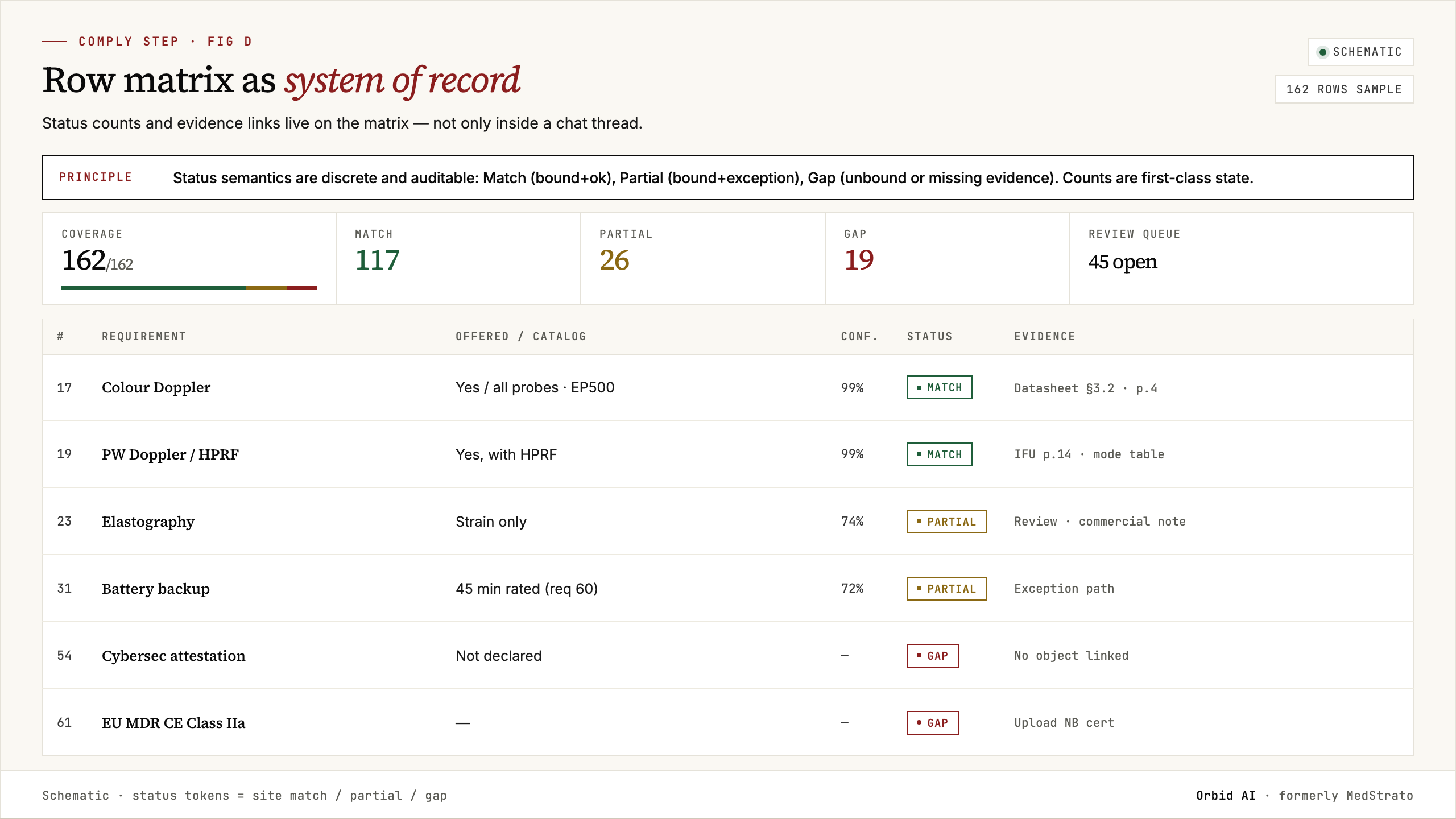
Counts in figures are illustrative for layout—not a published benchmark from your tenders.
Fig E — Export projection (schematic)
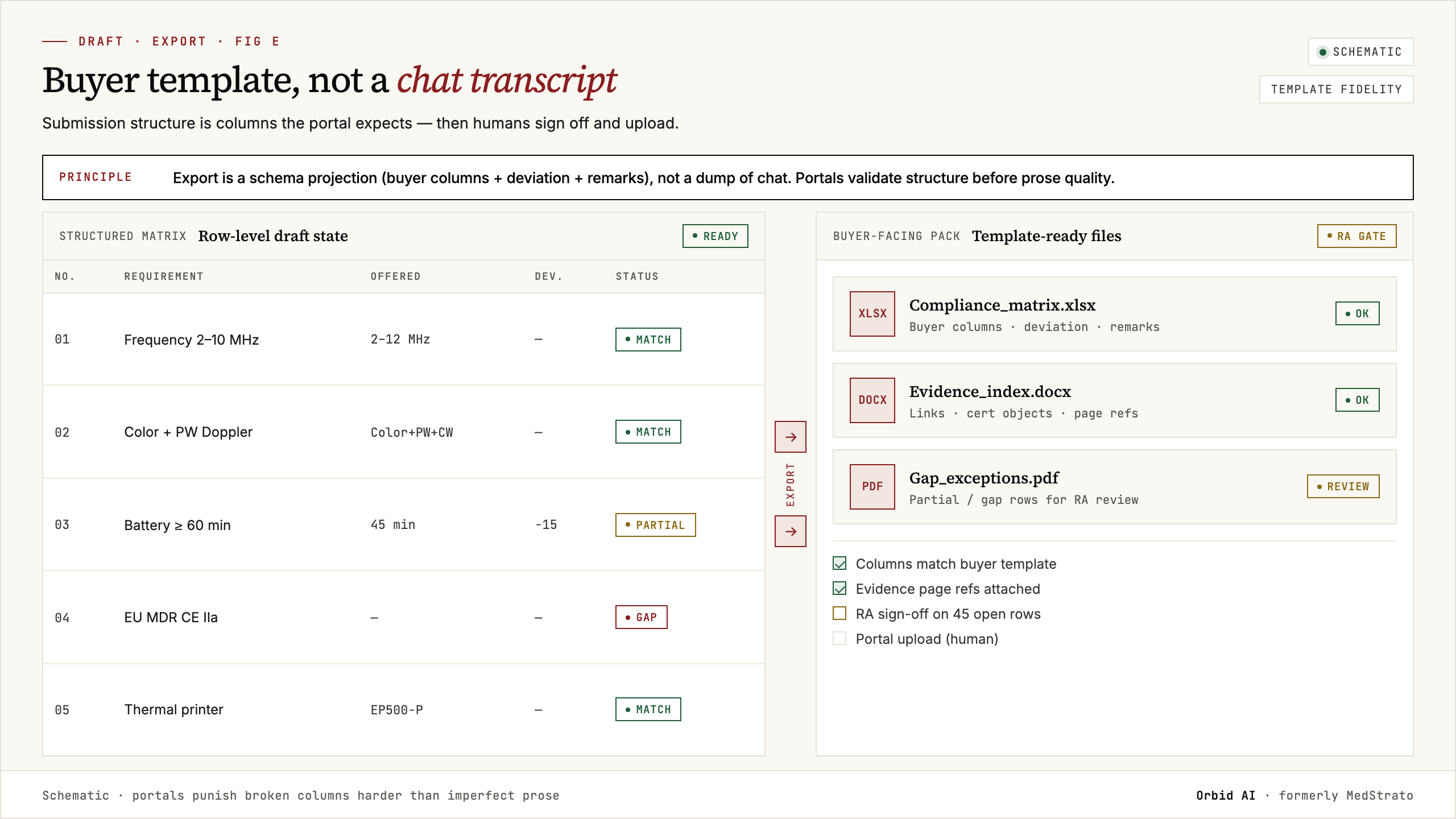
Export is structure first. Humans still own sign-off and portal upload.
Orbid AI path—and its limits (read this before a demo)
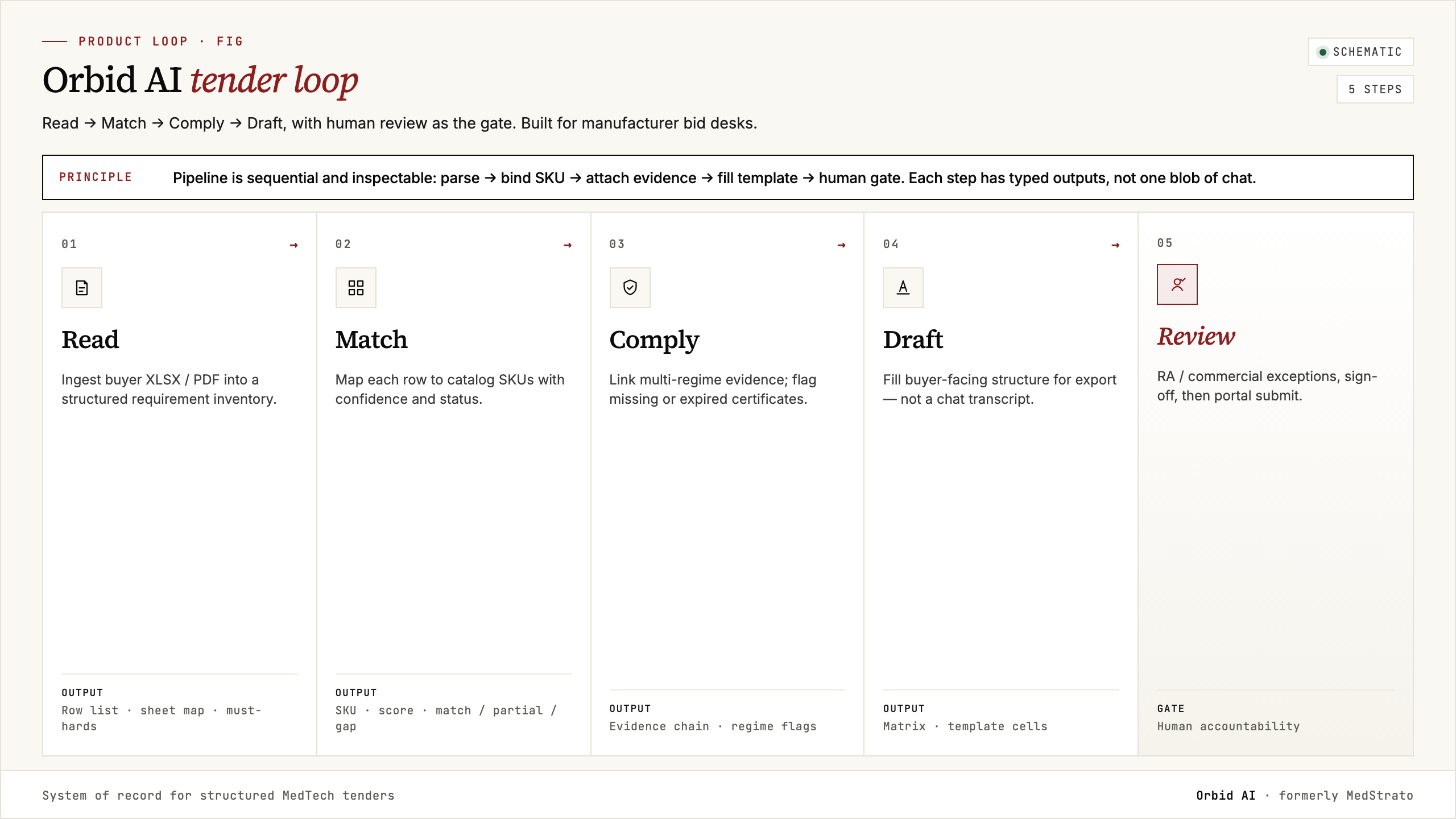
Read → Match → Comply → Draft, with human review as the gate. Brand note: Orbid AI is formerly MedStrato.
What we optimize for:
- Structured MedTech tenders with heavy specification tables
- Catalog-driven match with review states
- Linking multi-regime evidence (where your data is loaded)
- Buyer-template-oriented export for RA-ready drafts
What we do not claim on this page:
- Independent, third-party audited accuracy or speed scores for your portfolio
- That using Orbid removes regulatory risk or replaces RA/QA judgment
- That pricing strategy, commercial terms, relationship history, or narrative evaluation criteria become irrelevant
- That every tender format, language, and portal is equally smooth on day one
Costs and friction you should plan for:
- Catalog and certificate onboarding — dirty masters, variants, and multi-regime packs take calendar time; some teams need weeks of preparation
- Ongoing maintenance — new SKUs, expiry rotations, label changes
- Data sensitivity — full technical files and certificates in a vendor system is a security and procurement decision, not a free default
- Vendor lock-in and exit — ask how exports, data ownership, and parallel run work before you depend on one path
- Edge cases — poor scans, ambiguous “equivalent to” language, commercial-only rows, narrative scoring, unusual buyer portals, emerging-market local rules
- TCO — seat/usage price is only part of cost; include process change and dual-running your old path during pilot
Real-world friction examples (not exhaustive)
These are the kinds of situations that still require human judgment.
- Ambiguous equivalence language — When a buyer writes “compatible with existing Model X fleet” without numerical ranges or standards, bind confidence drops and the row is marked partial. Commercial/RA judgment is still required—we do not auto-accept equivalence claims.
- Dirty or multi-name catalogs — If the same SKU appears under three different commercial names across markets, matching quality is highly dependent on how much cleanup you complete before or during the pilot. We surface the ambiguity; we do not magically resolve ungoverned master data.
- Narrative evaluation criteria — Clauses such as “supplier must demonstrate clinical leadership” or relationship history fall outside the matrix loop. Those remain LLM-assisted + human-written.
Build-vs-buy is open: capable teams can assemble document AI + database + LLM agents + export jobs. Orbid is a packaged bet for desks that want that loop without owning the full software backlog. Compare us also to other tender/RFP software, not only to a bare chat window. General RFP content libraries (for example Loopio-class tools) excel at reusable narrative Q&A; we focus more on MedTech catalog binds and regulatory evidence objects for specification-heavy packs. Different jobs—sometimes both belong on the same desk.
How to evaluate fairly (use our bake-off idea against us)
We suggest a method. We do not ship audited results for your data on this page.
- Pick one 100+ row tender you already ran (won or lost).
- Freeze the same catalog sample and the same deadline.
- Run your current best path (Excel, LLM hybrid, other software—whatever you actually use).
- Run Orbid (or any alternative) on the same inputs.
- Score with the focus list below—adapt weights to your process.
Suggested scoring focus (adapt weights to your process)
- Unsupported or weakly evidenced claims
- Missing / expired certificates against the regimes you actually need
- Template column breakage or forced rebuild effort
- Calendar time to first RA-ready draft
- Rework volume after the first RA pass
- Hours spent preparing / cleaning catalog + certificate data (count this fully)
If your hybrid stack already wins on those metrics, keep it. If Orbid only wins after heroic data cleaning, count that cleaning as cost.
We are happy to run your pack live in a demo and walk through the partial/gap queue together. Prefer offline first? Use our free template: printable scoring sheet · CSV download.
When ChatGPT-first (or LLM-hybrid-first) is rational
- Work is mostly narrative, training, or internal analysis
- Specs and certificates already live in a trusted system of record
- You have engineering capacity to maintain bind + evidence + export yourself
- Tender volume or portfolio complexity does not justify another vendor
When a purpose-built tender system (including Orbid) is rational
- Awards hinge on large specification matrices and multi-regime evidence
- Template fidelity and shared review queues are chronic pain
- You want packaged MedTech-oriented workflow rather than assembling every layer in-house
- You accept onboarding and vendor due diligence as part of the deal
Using both is often the mature answer
Keep general LLMs for language, exploration, and drafting help. Keep a system of record—Orbid or yours—for catalog binds, evidence, and export. Humans keep strategy and sign-off. That is not fence-sitting; it is matching tools to jobs without pretending one chat window is a regulated bid system.
Definition of the automation loop: MedTech tender response automation. Implementation outline: guide.
Want to pressure-test the difference on your own files?
Book a demo — we will run a real tender with you and review the match / partial / gap queue together. Treat every claim on this page (including ours) as a hypothesis until it survives your data.
Features · pricing · try the product at orbid.dev · stack overview: general LLMs vs tender agents · peer detail: vs Claude · vs Doubao · vs Kimi.