Tender Response Automation Guide for MedTech Bid Teams
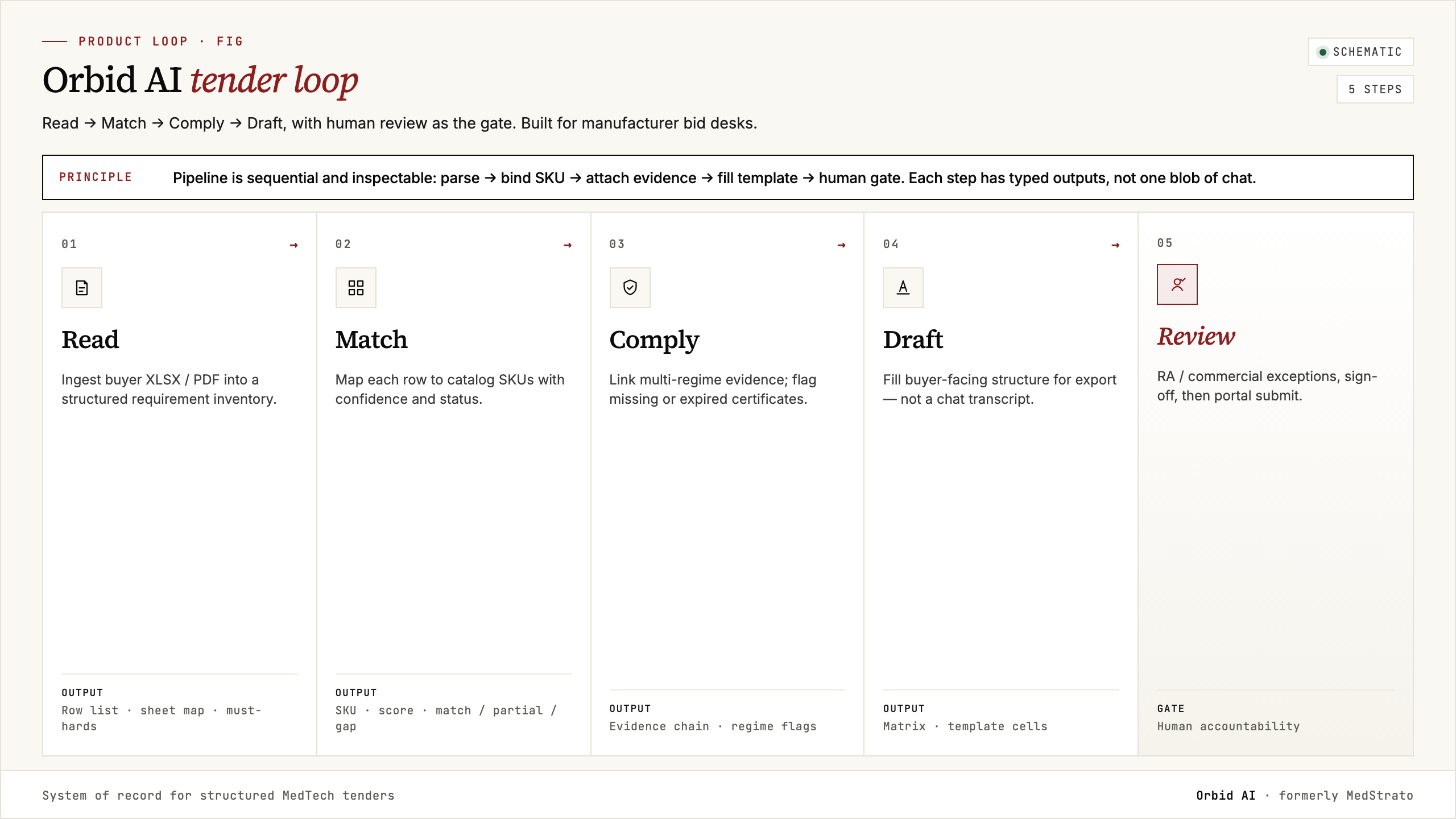
Answer first: This is the 5-step how-to for MedTech tender response automation and automated tender response on the manufacturer side: extract requirements, match specs, verify compliance, assemble evidence, export the buyer template. A native AI agent—Orbid AI (formerly MedStrato)—runs the mechanical loop; your bid lead and RA keep strategy and sign-off. Product definition: MedTech tender response automation pillar. Field map: software comparison. Demo: /book · product: orbid.dev.
If your bid team still prepares tenders manually — copying specs into spreadsheets, chasing datasheets, reviewing compliance line by line — you are spending roughly an order of magnitude more time than a 2026 agent-assisted desk.
Tender response automation: what it actually means
Tender response automation replaces the manual, error-prone steps of bid preparation with AI-driven workflows. It is not about generating marketing prose — it is about matching specifications, verifying compliance, and assembling evidence at machine speed while humans own go/no-go.
Why it matters in 2026
With hospital procurement cycles tightening and regulatory requirements (like EU MDR) demanding heavier documentation, manual bid teams are being outpaced. Automation compresses re-key work and surfaces certificate gaps earlier—it does not make submissions “mathematically free of compliance errors.” RA and bid leads still review.
The five steps that get automated:
- Requirement extraction — parsing tender documents (PDF, Excel, Word) into structured line items
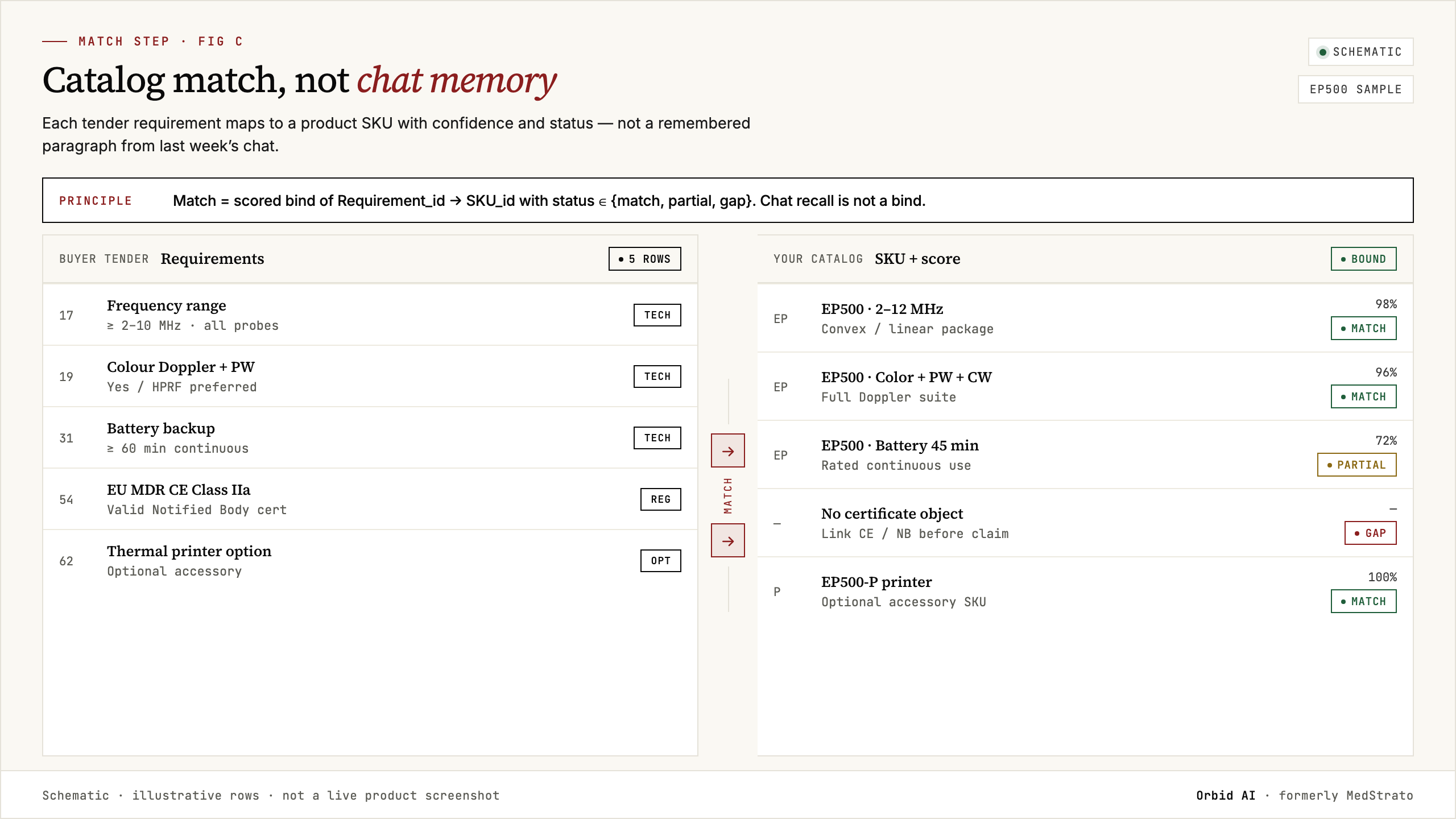
- Spec matching — mapping each requirement to your product catalog with confidence scores
- Compliance verification — checking regulatory status (FDA clearance, CE marking, etc.) for each matched product
- Evidence gathering — pulling datasheets, certificates, and test reports from your document repository
- Document assembly / export — formatting toward the buyer’s template, not a generic AI PDF
Automated tender response: the manufacturer workflow
Automated tender response is the end-to-end desk workflow—not a single button. Treat each pack as a pipeline:
- Intake — drop the buyer file as received (do not retype into a questionnaire first)
- Structure — normalize rows, units, and regime tags so matching can score full / partial / gap
- Bind catalog — map every technical requirement to sellable SKUs and certificate state
- Bind evidence — attach claim-to-source links (datasheet page, certificate ID, test report)
- Export + gate — land in the buyer template; bid lead and RA approve before submit
Desks that skip steps 3–4 and only automate prose generation create compliance risk. Purpose-built medtech tender automation keeps structured state next to every row. Definition of the product job: MedTech tender response automation.
Manual vs agent-assisted (typical multi-row device pack)
Directional ranges for a ~150-row medical device tender:
| Phase | Manual | Agent-assisted |
|---|---|---|
| Requirement extraction | Hours | Minutes or less |
| Spec matching | Many hours | Often tens of seconds on clean catalogs* |
| Compliance check | Hours | Minutes + RA review |
| Evidence gathering | Hours | Minutes |
| Human review & strategy | Hours | Hours (kept) |
| Typical total | Multi-day | Review-only hours |
*Matching-phase timing is an illustrative internal benchmark—validate on your tenders and catalog.
The human review step stays — automation removes drudgery, not judgment.
Why generic RFP tools don't work for medical devices
Tools like Loopio, Responsive, and RFPIO were built for IT and professional services RFPs. They use content libraries and keyword matching. Medical device tenders require something fundamentally different:
- Regulatory awareness — Does your product hold the right FDA 510(k) clearance or CE marking for this specific requirement?
- Spec-level precision — The tender says "flow rate 0.1–999 mL/hr." Your product does 0.1–1200 mL/hr. A keyword match misses this; spec matching catches it.
- Evidence chains — Every claim needs a traceable source: datasheet page 4, certificate number X, test report section Y. Generic tools don't build evidence chains.
- Multi-regime compliance — A single tender might reference FDA, ISO 13485, IEC 60601, and local registration requirements simultaneously.
MedTech tender automation software checklist
When shortlisting tender automation software for a manufacturer desk, score each vendor on these jobs—not on generic “AI RFP” marketing:
| Capability | Why it matters | Pass signal |
|---|---|---|
| Catalog bind | Rows map to real SKUs | Full / partial / gap with confidence |
| Regime evidence | Disqualification risk | Certificate state per line, expiry flags |
| Buyer export | Submission fidelity | Buyer columns filled, not a generic PDF |
| Audit trail | Post-award challenge | Claim → source document links |
| Human gate | RA ownership | Review queue, not auto-submit |
Compare the field in our tender management software comparison and head-to-heads such as Orbid AI vs AutoRFP.ai and vs Loopio.
What to look for in a tender automation agent
Not all automation is equal. Evaluate tools against these criteria:
- Accuracy — Ask for false-positive definitions and bake-offs on your tenders, not demo data alone.
- Regulatory coverage — How many regulatory regimes does it support? You need at least FDA, EU MDR, and your primary markets.
- Document parsing — Can it handle messy PDFs, scanned documents, and multi-tab Excel?
- Integration — Does it connect to your existing product catalog, document management system, and ERP?
- Audit trail — Can you trace every matched spec back to a source document? This matters for post-award audits.
- Security — SOC 2 Type II, encryption, and data residency are non-negotiable for medical device companies.
Implementation roadmap
Typical deployment timeline for a mid-size medical device company:
- Weeks 1–2: Pilot with 2–3 historical tenders, calibrate matching accuracy
- Weeks 3–4: Product catalog and document repository integration
- Weeks 5–8: Live deployment on new tenders with parallel manual verification
- Month 3+: Full production use, manual verification focused on edge cases and RA gates
Most desks see the labor case during pilot. For frameworks, see our ROI calculation guide (desk metrics—not sticker price).
MedTech tender automation vs generic RFP tools
Generic RFP automation tools (Loopio, Responsive, RFPIO) excel at text-based questionnaires — company descriptions, process explanations, approach statements. But medical device tenders aren't questionnaires. They're specification tables with 150+ rows of technical parameters, regulatory compliance requirements, and evidence demands.
The critical differences:
- Specification matching vs text generation: Medtech tenders require matching "operating frequency 2.5-10 MHz" against your datasheet's "broadband frequency range: 2-12 MHz" with semantic understanding. Generic tools can't do this.
- Regulatory compliance verification: Every compliance claim in a medical device tender must be backed by a valid certificate (FDA 510(k), EU MDR, MHRA). Generic tools generate plausible text without verification — a disqualification risk.
- Evidence chains: Each response row needs a traceable link to the source document (datasheet page, test report section, regulatory filing). This is unique to regulated industries.
Orbid AI is purpose-built for this loop: it reads the tender, matches specifications against your product catalog, cross-checks regulatory status across regimes listed on the product site, and drafts a response with evidence links—humans review and submit.
Field map: tender management software comparison · tracking layer: tender tracking for manufacturers.
How to measure success
Track desk outcomes—not vanity impressions:
| Metric | Manual baseline | Direction with automation |
|---|---|---|
| Tender response cycle | Multi-week | Toward review-only days |
| Evidence gaps found pre-submit | Late / manual | Earlier, line-level |
| Tenders per team / month | Capacity-capped | Higher with same headcount |
| RA trust in audit trail | Spreadsheet archaeology | Claim-to-source links |
The bottom line
Tender response automation is table stakes for competitive medical device bid desks in 2026. Teams that automate the mechanical loop respond to more tenders with the same headcount and free specialists for strategy instead of copy-paste compliance—without pretending AI replaces RA.
See it work on your own tender — bring a real multi-tab pack. Also: features · orbid.dev · automation pillar · software comparison.