← Journal
ProcurementStrategyAI

Bio Pharma Procurement Strategy 2026: From Manual Tenders to AI-Driven Transformation

11 June 2026

The bio pharma procurement strategy landscape in 2026 bears little resemblance to the manual, spreadsheet-driven processes of even five years ago. Pharmaceutical procurement teams face a perfect storm: the largest patent cliff in history is reshaping supplier landscapes, advanced therapy medicinal products (ATMPs) demand entirely new procurement frameworks, and regulatory divergence across the FDA, EMA, and MHRA requires multi-jurisdiction compliance at scale. This guide provides a comprehensive roadmap for bio pharma procurement transformation — from understanding the unique challenges of pharmaceutical purchasing to implementing AI-driven automation that delivers measurable results.

How bio pharma procurement differs from medical device procurement

While medical device procurement and pharmaceutical procurement share common goals — securing the right products at the right price with full regulatory compliance — the operational realities diverge significantly. Understanding these differences is essential for any organisation pursuing a credible bio pharma procurement strategy.

Regulatory pathways: drugs vs devices

Medical devices follow pathways like FDA 510(k), PMA, or the EU MDR CE marking process. Pharmaceuticals navigate entirely different regulatory frameworks: New Drug Applications (NDAs), Biologics License Applications (BLAs), and Marketing Authorisation Applications (MAAs) under the EMA. Each pathway has distinct documentation requirements, clinical evidence thresholds, and post-market surveillance obligations that procurement teams must verify during supplier qualification.

Clinical trial supply chains

Pharma procurement often involves managing clinical trial supply chains alongside commercial supply. This means handling investigational medicinal products (IMPs), comparator drugs, and placebo supplies — each with its own regulatory, labelling, and distribution requirements. Device procurement rarely involves this level of parallel supply chain complexity.

Cold chain and batch tracking

Biologics, vaccines, and many specialty pharmaceuticals require unbroken cold chain management from manufacturer to patient. Procurement teams must verify cold chain capabilities during supplier qualification, specify temperature monitoring requirements in tender documents, and maintain batch-level traceability for recall readiness. While some medical devices require controlled storage, the scale and criticality of cold chain in pharma procurement is fundamentally different.

Expiry management and shelf life

Pharmaceutical procurement must account for product expiry dates in ways that device procurement typically does not. Short-dated stock management, minimum remaining shelf life requirements in tender specifications, and waste reduction strategies are core components of any effective pharma purchasing operation.

Key challenges in bio pharma procurement: 2026

Three converging forces are reshaping pharmaceutical procurement in 2026, and each demands a strategic response.

The patent cliff and biosimilar procurement shifts

Between 2025 and 2028, patents on biologic drugs worth over $120 billion in annual revenue are expiring. This creates both opportunity and complexity for procurement teams. Biosimilar entry means new supplier qualification processes, reference product comparisons, and pricing negotiations that didn't exist when the originator held exclusivity. Procurement teams need strategies for:

  • Biosimilar tender evaluation: Developing scoring matrices that balance price savings against switching costs, clinical familiarity, and supply security.
  • Multi-source contracting: Qualifying multiple biosimilar suppliers to avoid single-source dependency while maintaining formulary coherence.
  • Transition management: Coordinating with clinical teams on switching protocols, pharmacovigilance requirements, and patient communication during originator-to-biosimilar transitions.

ATMP procurement complexity

Advanced therapy medicinal products — including cell therapies, gene therapies, and tissue-engineered products — represent the fastest-growing segment of pharmaceutical procurement, and the most complex. ATMP procurement challenges include:

  • Patient-specific manufacturing: Autologous cell therapies are manufactured for individual patients, making traditional volume-based procurement models irrelevant.
  • Vein-to-vein logistics: Procurement must coordinate apheresis, shipping to manufacturing facilities, cryopreservation, and return logistics — often across international borders.
  • Outcome-based pricing: Many ATMPs are priced at $500,000+ per treatment, driving payers and procurement teams toward outcomes-based contracts where payment is contingent on clinical response.
  • Hospital readiness: ATMP procurement extends beyond the product itself to include facility accreditation, staff training, and monitoring infrastructure.

Multi-agency regulatory compliance

Post-Brexit regulatory divergence means pharmaceutical suppliers and procurement teams must now manage compliance across three major agencies independently: the FDA (United States), EMA (European Union), and MHRA (United Kingdom). Each agency has distinct requirements for product registration, labelling, pharmacovigilance, and tender documentation. A robust bio pharma procurement strategy must include automated compliance checking that maps product dossiers against the requirements of each target market.

AI-driven bio pharma procurement transformation

The scale of these challenges makes manual procurement processes unsustainable. Bio pharma procurement transformation in 2026 centres on four AI-driven capabilities.

Automated supplier qualification

AI systems can now ingest supplier documentation — GMP certificates, regulatory approvals, pharmacovigilance system master files, and quality agreements — and automatically assess qualification status against predefined criteria. This reduces supplier qualification timelines from months to weeks and ensures continuous monitoring of supplier compliance status. When a supplier's GMP certificate approaches expiry or a regulatory warning letter is issued, the system alerts procurement teams immediately.

Tender response automation for pharma

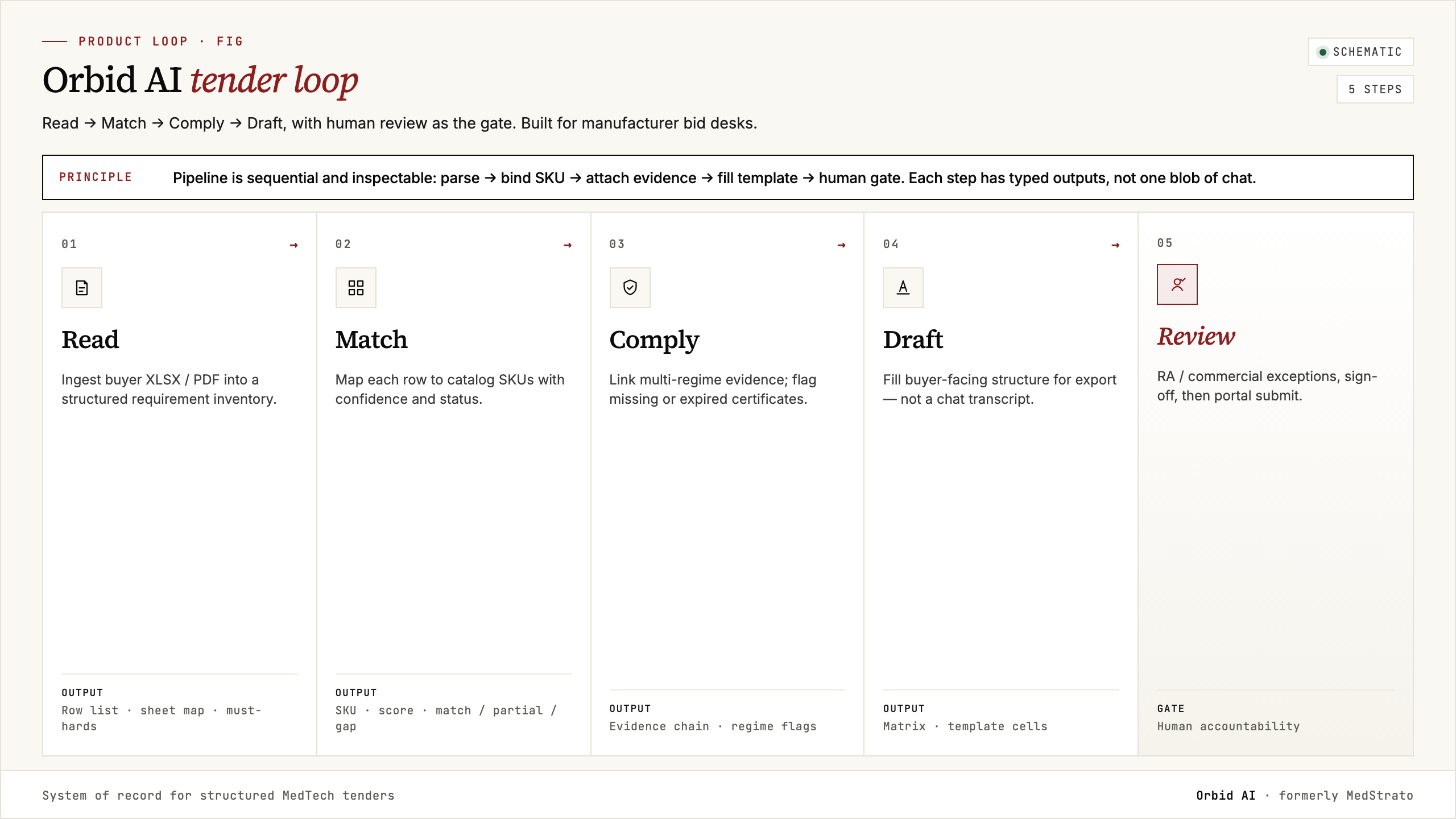
Pharmaceutical tender responses are document-intensive, requiring product dossiers, pricing schedules, regulatory certificates, supply chain documentation, and clinical evidence packages. Orbid, MedStrato's AI agent, automates the assembly and drafting of tender responses by:

  • Extracting requirements from tender documents across multiple languages
  • Matching requirements against your approved product portfolio and documentation library
  • Flagging compliance gaps before submission deadlines
  • Generating first-draft responses that procurement specialists review and approve
  • Tracking version history and audit trails for regulatory compliance

Teams using AI-assisted tender response report 60–75% reductions in response preparation time, allowing them to pursue more opportunities without expanding headcount.

Compliance checking across FDA, EMA, and MHRA

Automated compliance engines cross-reference your product registrations, certificates, and labelling against the specific requirements of each tender. For a single product tendered across the US, EU, and UK markets, this means verifying:

  • FDA approval status, NDC numbers, and Orange Book listings
  • EMA marketing authorisation, EURD list compliance, and EU QPPV designation
  • MHRA registration, UK-specific labelling requirements, and CPRD reporting compliance

Manual verification of these requirements for a portfolio of even 50 products across 10 markets is a full-time job. AI reduces this to a continuous, automated process with exception-based human review.

Predictive analytics for procurement planning

AI models analyse historical tender volumes, seasonal demand patterns, competitor behaviour, and regulatory pipeline data to forecast procurement opportunities. This allows pharma commercial teams to pre-position inventory, prepare documentation, and allocate bid team resources proactively rather than reactively.

Tender strategies specific to pharmaceutical procurement

Pharmaceutical tenders have structural characteristics that distinguish them from device tenders. An effective bio pharma procurement strategy addresses each of these.

Framework agreements and volume commitments

Many hospital and GPO pharmaceutical tenders are structured as multi-year framework agreements with volume bands rather than fixed quantities. Procurement teams must model pricing across volume scenarios, build in price adjustment mechanisms for raw material cost changes, and negotiate minimum order quantities that balance supply security against inventory carrying costs.

Parallel trade considerations

In the EU, parallel trade — the legal importation of pharmaceuticals from lower-priced to higher-priced member states — adds a layer of complexity to tender pricing strategy. Procurement teams must consider:

  • How parallel-traded products affect tender competitiveness in high-price markets
  • Repackaging and relabelling compliance requirements for parallel-traded products
  • Supply security risks when parallel traders divert supply from intended markets
  • Anti-diversion clauses in tender contracts and their enforceability

Formulary and therapeutic substitution

Unlike device procurement, pharmaceutical tenders often involve formulary decisions where therapeutic alternatives (not just generic equivalents) compete for the same tender lot. Procurement teams must work closely with pharmacy and therapeutics (P&T) committees, presenting clinical and economic evidence that positions their product favourably against therapeutic competitors — not just price competitors.

Controlled substance and cold chain documentation

Tenders for controlled substances require additional documentation: DEA registration (US), Home Office licensing (UK), and national narcotics authority permits across EU member states. Cold chain products require temperature excursion protocols, validated shipping lane documentation, and contingency plans. These requirements must be systematically addressed in every tender response.

How MedStrato and Orbid help pharma procurement teams

MedStrato's platform is purpose-built for the complexity of pharmaceutical and medical device tender management. For pharma procurement teams specifically, the platform delivers:

  • Global tender monitoring: Automated tracking of pharmaceutical tenders across 40+ countries, with AI-powered classification by therapeutic area, molecule, and procurement type.
  • Regulatory compliance engine: Continuous verification of product registrations, GMP certificates, and market authorisations against tender requirements across FDA, EMA, and MHRA jurisdictions.
  • Orbid AI agent: Orbid drafts tender responses using your approved product documentation, pricing databases, and compliance records — reducing response time by up to 75% while maintaining full audit trails.
  • Biosimilar competitive intelligence: Track biosimilar tender awards, pricing trends, and market share shifts across your therapeutic areas to inform pricing strategy and market entry timing.
  • Portfolio-wide tender pipeline: Visualise upcoming tender deadlines, renewal dates, and framework agreement expirations across your entire product portfolio and geographic footprint.

Getting started with bio pharma procurement transformation

Transforming pharmaceutical procurement from manual processes to AI-driven workflows doesn't require a multi-year implementation programme. Most MedStrato customers are live within 4–6 weeks, starting with tender monitoring and progressively activating compliance automation and AI-powered response drafting.

The first step is understanding your current tender coverage gaps and compliance bottlenecks. Book a demo to see how MedStrato maps your product portfolio against active and upcoming pharmaceutical tenders across your target markets. Or explore Orbid to understand how AI-assisted tender response works for pharmaceutical companies managing complex, multi-jurisdiction bids.

Conclusion

The bio pharma procurement strategy playbook for 2026 is clear: manual processes cannot scale to meet the demands of patent cliff biosimilar transitions, ATMP procurement complexity, and multi-agency regulatory compliance. Organisations that invest in bio pharma procurement transformation — particularly AI-driven tender automation and compliance verification — will win more tenders, reduce compliance risk, and free their procurement teams to focus on strategic decisions rather than administrative burden. The tools exist today. The competitive advantage goes to those who deploy them first.

Frequently asked questions

Bio Pharma Procurement Strategy 2026

How does bio pharma procurement differ from medical device procurement?

Bio pharma procurement involves drug-specific regulatory pathways (NDA/BLA vs 510(k)/PMA), clinical trial supply chain management, cold chain logistics, batch-level traceability, and expiry date management. Medical device procurement focuses more on technical specifications, installation, and long-term service contracts. Pharma procurement must also navigate patent exclusivity windows, biosimilar entry timelines, and parallel import regulations that have no equivalent in the device world.

What is the biggest challenge in pharmaceutical procurement in 2026?

The convergence of three forces: the patent cliff creating urgent biosimilar sourcing decisions, the rise of ATMPs (advanced therapy medicinal products) requiring entirely new procurement frameworks for cell and gene therapies, and tightening regulatory divergence between the FDA, EMA, and MHRA post-Brexit. Procurement teams that lack automation struggle to manage compliance across all three simultaneously.

Can AI really automate pharma tender responses?

Yes. Modern AI platforms like MedStrato's Orbid agent can draft compliant tender responses by pulling from approved product dossiers, pricing databases, and regulatory documentation. The AI checks requirements against your product portfolio, flags compliance gaps, and generates first-draft responses that procurement specialists review and refine — reducing response time from weeks to days.

How does MedStrato help with bio pharma procurement transformation?

MedStrato provides end-to-end tender intelligence for pharmaceutical companies: automated monitoring of pharma tenders across 40+ countries, AI-powered compliance verification against FDA/EMA/MHRA requirements, and Orbid — an AI agent that drafts tender responses using your approved documentation. Book a demo at medstrato.com/book to see the platform in action.

Related articles

Your next tender
is due Friday.

Bring fifty line items. Leave with a submission-ready file.

Request accessTalk to a founder