Best Tender Management Software for Medical Devices in 2026: 7 Tools Compared
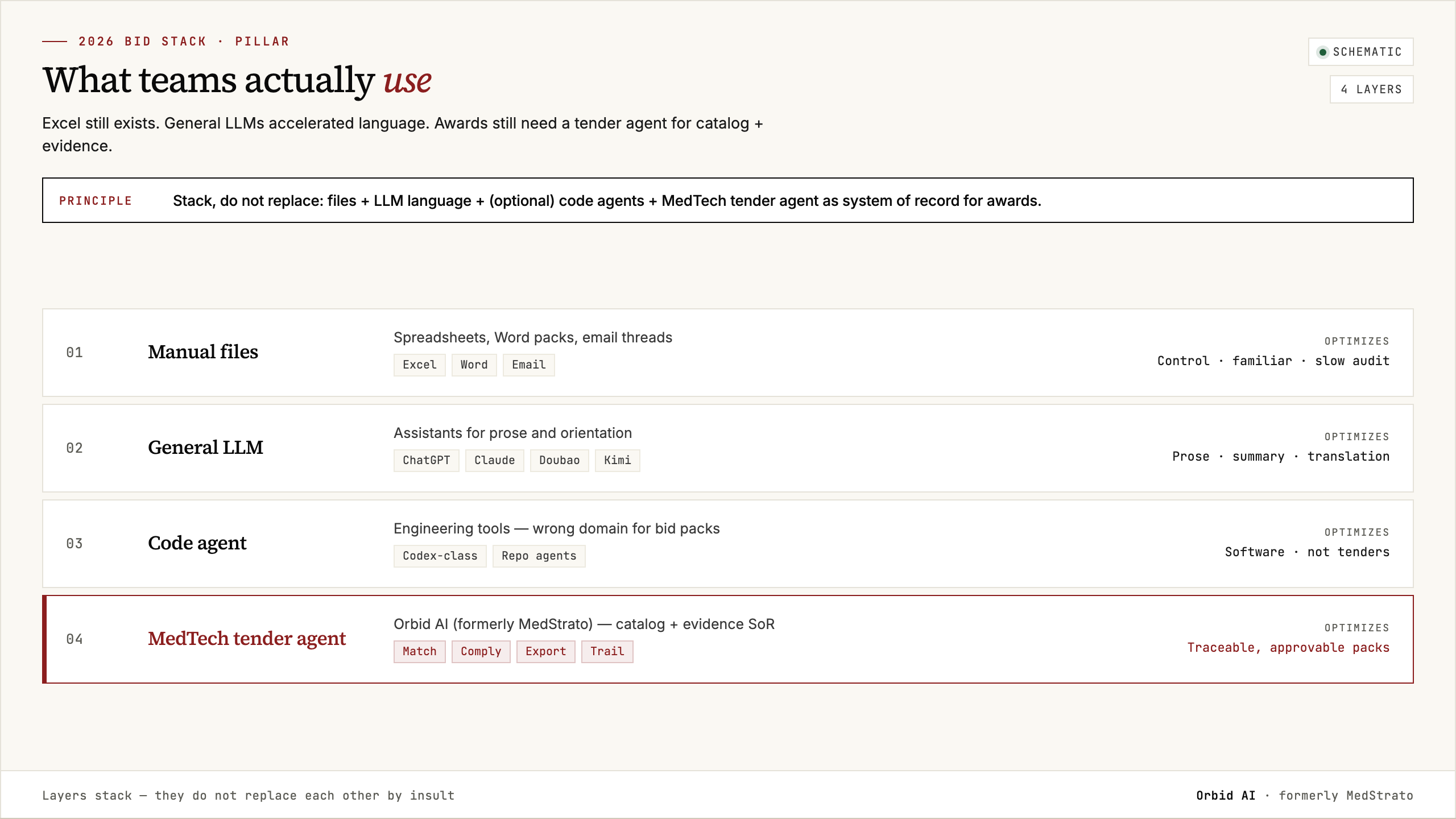
Choosing the right tender management software can make or break your medical device company's procurement success. With hospital systems and GPOs issuing increasingly complex tenders — demanding regulatory compliance evidence, detailed specification matching, and multi-language documentation — the days of managing bids in spreadsheets are over.
We evaluated 7 tender management platforms based on their suitability for medical device and medtech companies. This comparison covers features, pricing, regulatory coverage, and recommendations based on team size and tender volume. Whether you handle 5 tenders per month or 50, this guide will help you find the right fit.
Quick comparison: 7 tender management tools at a glance
| Platform | Best for | Medtech-specific | Regulatory regimes | Starting price | AI capabilities | Languages |
|---|---|---|---|---|---|---|
| MedStrato | Medtech regulatory compliance | Yes | 14 regimes | $2,400/mo | Spec matching, compliance verification | Cross-language matching |
| TenderEyes | Large medtech + Office integration | Yes | Multiple (varies) | Custom pricing | AI auto-population | Multi-language |
| Cube RM | Pharma + large medtech | Yes (life sciences) | Multiple | Custom pricing | Tender intelligence, hospital doc analysis | Multi-language |
| AutoRFP.ai | High-volume generic tenders | No | None built-in | $899/mo | Libraryless semantic answering | Multi-language |
| Loopio | IT/services RFP responses | No | None built-in | Custom pricing | Content library matching | Per-library |
| Responsive (RFPIO) | Enterprise content-heavy proposals | No | None built-in | Custom pricing | Knowledge base suggestions | Per-library |
| Altura | Established bid teams | No | None built-in | Custom pricing | Tender analysis | Limited |
1. MedStrato — Purpose-built for medical device tenders
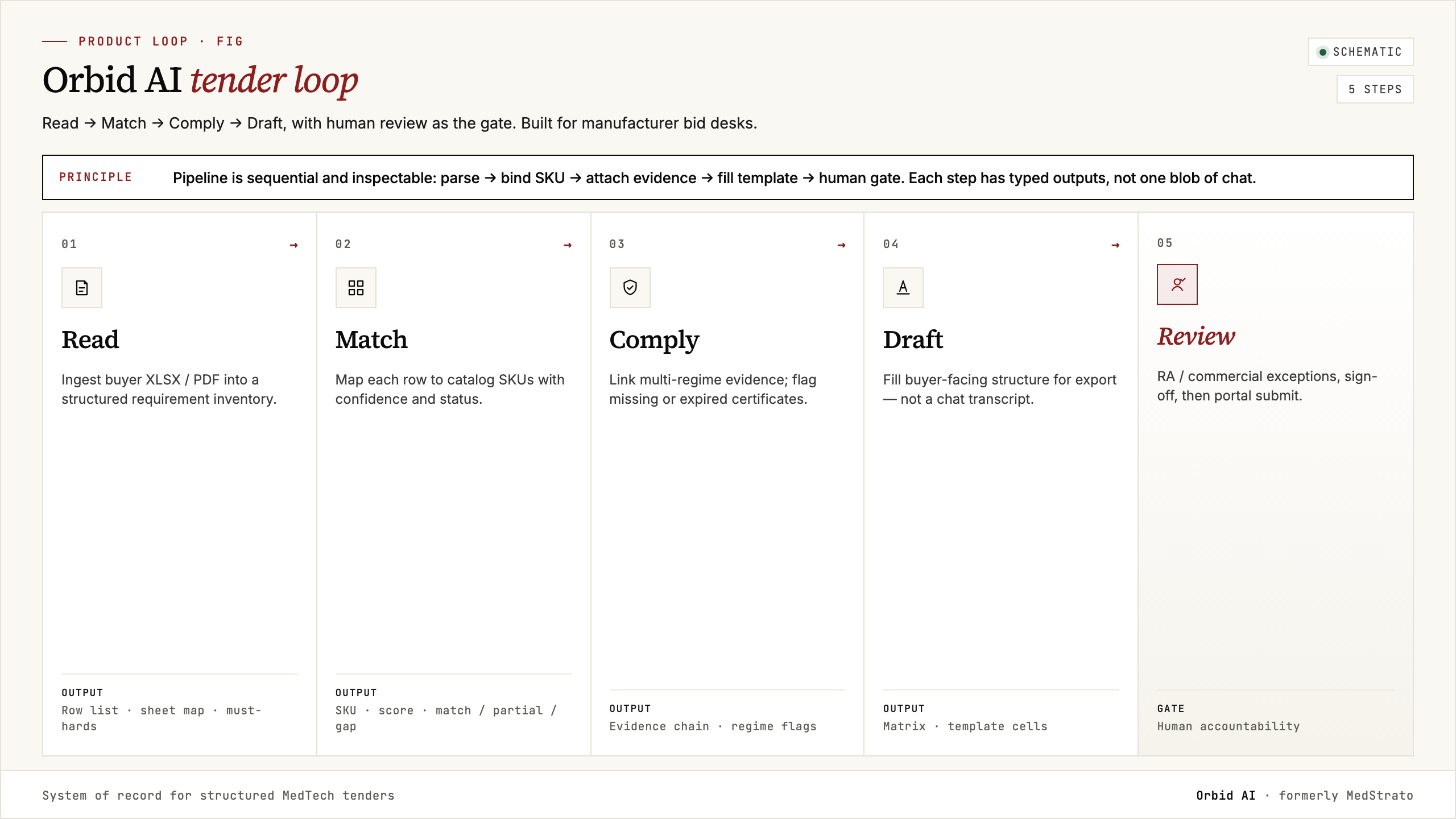
MedStrato is the only tender management platform built from the ground up for medical device companies. Instead of retrofitting a generic RFP tool with healthcare content, MedStrato's architecture is designed around the unique challenges of medtech procurement: regulatory compliance across multiple jurisdictions, specification-level matching with numerical precision, and evidence chain generation that satisfies quality system auditors.
Key strengths
- 46-second specification matching — Upload a tender document and receive matched product recommendations with compliance verification in under a minute
- 97% matching accuracy — Purpose-built semantic engine understands units, ranges, tolerances, and technical equivalences (not just keyword similarity)
- 14 regulatory regimes — Automated compliance checking across FDA 510(k), EU MDR 2017/745, NMPA, TGA, HSA, Health Canada, ANVISA, PMDA, KFDA, SAHPRA, and more
- Evidence chains — Every claim in your tender response is automatically linked to its source document (datasheet, certificate, test report)
- Cross-language matching — Tender in German, product specs in English? No problem. The semantic engine works across languages without requiring separate content libraries
- Unstructured document parsing — Handles messy PDFs, scanned documents, and non-standard tender formats that trip up generic tools
Pricing
$2,400/month. Includes unlimited users, unlimited tenders, and all 14 regulatory regimes. No per-seat pricing, no module upsells. See full pricing details.
Best for
Medical device companies of any size that need regulatory compliance automation. Particularly strong for teams responding to international tenders across multiple regulatory jurisdictions. If you're spending hours manually cross-checking regulatory documentation for each bid, MedStrato eliminates that bottleneck entirely.
Book a demo to see the 46-second matching in action on your own tender documents.
2. TenderEyes — MedTech solution with Microsoft 365 integration
TenderEyes positions itself as the #1 tender management platform for the MedTech sector. Its primary differentiator is deep integration with Microsoft 365 (Word, Excel, SharePoint, Teams), making it a natural fit for large medtech organizations already embedded in the Microsoft ecosystem.
Key strengths
- Microsoft 365 native — Work directly within Word and Excel rather than switching to a separate web application
- AI auto-population — Uses AI to suggest answers based on previous successful submissions
- MedTech focus — Built with medical device workflows in mind, including document management for regulatory submissions
- Collaboration workflows — Strong team coordination features for large bid teams with multiple contributors
- Template management — Reusable templates for common tender formats in different markets
Pricing
Custom enterprise pricing. Contact TenderEyes for a quote. Typically suited for organizations with 20+ users.
Best for
Large medtech companies (100+ employees) that are heavily invested in Microsoft 365 and want tender management integrated into their existing Office workflow rather than adopting a standalone platform. If your team lives in Word and SharePoint, TenderEyes minimizes context switching.
Limitations
Microsoft dependency means teams using Google Workspace or other productivity suites won't benefit from the core value proposition. Regulatory compliance automation is less comprehensive than MedStrato's 14-regime approach.
3. Cube RM — Life sciences tender lifecycle management
Cube RM brings over 25 years of experience in life sciences tender management. It covers the full tender lifecycle from opportunity identification through to contract management, with particular strength in pharmaceutical and large medical device tenders.
Key strengths
- Tender intelligence — Identifies upcoming tender opportunities across markets before they're published
- Hospital document analysis — Analyzes hospital procurement documents to extract requirements and scoring criteria
- 25+ years of domain expertise — Deep understanding of life sciences procurement processes and workflows
- Global coverage — Supports tender processes across multiple countries and healthcare systems
- Contract lifecycle management — Extends beyond the tender response into contract execution and renewal tracking
Pricing
Custom enterprise pricing. Typically positioned for mid-to-large organizations with significant tender volumes.
Best for
Pharmaceutical companies and large medical device manufacturers managing complex global tenders. If you need end-to-end lifecycle management from opportunity identification through contract management — and you have the budget for a comprehensive enterprise solution — Cube RM delivers breadth of coverage.
Limitations
Enterprise-oriented pricing and implementation may not suit smaller medtech companies. The breadth of the platform means it's less specialized in the rapid specification matching and automated compliance verification where purpose-built tools like MedStrato excel.
4. AutoRFP.ai — High-volume generic tender responses
AutoRFP.ai is designed for companies handling high volumes of tenders (40-200+ per year) and needing to respond quickly without maintaining a traditional content library. Its "libraryless" approach uses semantic AI to generate answers from your existing documentation.
Key strengths
- Libraryless semantic answering — No need to pre-build and maintain a content library. The AI generates responses from your source documentation
- High-volume optimization — Designed for teams handling 40-200+ tenders annually
- Fast setup — No weeks-long content library build; upload your documents and start responding
- Affordable entry point — $899/month makes it accessible for smaller teams
- Cross-format support — Handles various tender document formats
Pricing
Starting at $899/month. Volume-based tiers available for larger teams.
Best for
B2B companies handling large numbers of tenders across multiple industries. If you're a diversified supplier responding to 100+ generic tenders per year and need speed over specialization, AutoRFP.ai delivers strong ROI.
Limitations
Not built for medical devices specifically. No regulatory compliance awareness, no specification-level matching for technical parameters, and no evidence chain generation. For medtech companies, the time saved on generic answers is often lost on manual compliance verification. See our guide on tender response automation for more on why domain-specific tooling matters.
5. Loopio — Content library RFP tool
Loopio is one of the most established RFP response platforms, used by thousands of companies across industries. It pioneered the content library approach where teams pre-write and approve answers that get suggested for future RFPs.
Key strengths
- Mature content library — Well-designed system for organizing, reviewing, and refreshing pre-approved answers
- Wide adoption — Large user community and extensive integration ecosystem
- Collaboration features — Strong workflows for assigning sections to subject matter experts
- Analytics — Track win rates, response times, and content usage
- Import/export flexibility — Supports many document formats for intake and output
Pricing
Custom pricing based on team size. Typically $300-$500 per user per month for mid-market teams.
Best for
IT companies, SaaS vendors, and professional services firms responding to text-heavy RFPs where the questions repeat across opportunities. If most of your RFP work involves answering "Do you support SSO?" and "Describe your disaster recovery process" repeatedly, Loopio is excellent.
Limitations
No medical device regulatory awareness. Cannot match numerical specifications or verify compliance against regulatory regimes. The content library model requires significant maintenance investment — answers go stale and need regular review. For medtech companies, the comparison with purpose-built tools reveals significant gaps in specification handling and compliance automation.
6. Responsive (formerly RFPIO) — Enterprise knowledge base
Responsive (rebranded from RFPIO) is an enterprise-grade platform that centers on a knowledge base approach. It aggregates institutional knowledge and uses AI to surface relevant content for proposal responses.
Key strengths
- Knowledge base architecture — Aggregates content from multiple sources into a searchable knowledge base
- Enterprise integrations — Deep CRM integration (Salesforce, HubSpot) and collaboration tool support
- AI-powered suggestions — Machine learning recommends relevant content based on question context
- Proposal management — Full lifecycle from intake through approval and submission
- Security questionnaire automation — Strong at handling repetitive security and compliance questionnaires
Pricing
Custom enterprise pricing. Generally positioned for larger organizations (50+ employees in sales/presales).
Best for
Large enterprises with significant proposal volumes and complex content approval workflows. If you have a large sales engineering or presales team handling diverse proposal types, Responsive provides the infrastructure to manage that at scale.
Limitations
Like Loopio, Responsive is industry-agnostic and lacks medical device specialization. No regulatory regime awareness, no specification matching beyond text similarity, and no evidence chain generation. The enterprise pricing model may not deliver ROI for medtech companies whose primary challenge is regulatory compliance, not content management.
7. Altura — Structured bid management
Altura focuses on mature bid processes with emphasis on tender analysis and workflow structure. It's designed for teams that have established bid management practices and want software to enforce discipline and consistency.
Key strengths
- Tender analysis — Structured approach to evaluating tender requirements and scoring criteria
- Bid/no-bid framework — Formal decision framework for qualifying tender opportunities
- Workflow structure — Enforces process discipline across the bid team
- Win theme development — Tools for developing and tracking competitive win themes
- Review management — Multi-stage review workflows (Red Team, Gold Team, etc.)
Pricing
Custom pricing based on team size and requirements.
Best for
Established bid teams (typically 10+ people) that want to impose structure and repeatability on their bid process. If your challenge is process discipline rather than content generation or compliance verification, Altura provides the governance framework.
Limitations
Not specialized for medical devices or any specific industry. More focused on process management than automated content generation or compliance checking. Teams looking for AI-powered matching or regulatory automation will need to supplement Altura with other tools.
Detailed feature comparison
| Feature | MedStrato | TenderEyes | Cube RM | AutoRFP.ai | Loopio | Responsive | Altura |
|---|---|---|---|---|---|---|---|
| Spec matching (numerical) | Yes (46s) | Partial | Partial | No | No | No | No |
| Regulatory compliance auto-check | 14 regimes | Limited | Some | No | No | No | No |
| Evidence chain generation | Automatic | Manual | Manual | No | Manual | Manual | No |
| Unstructured document parsing | Yes (OCR + AI) | Yes | Yes | Yes | Limited | Limited | Limited |
| Cross-language matching | Yes | Partial | Yes | Partial | No | No | No |
| Content library | Product catalog model | Yes | Yes | Libraryless | Yes (core) | Yes (core) | Limited |
| Bid/no-bid analysis | Yes | Yes | Yes | No | Limited | Limited | Yes (core) |
| CRM integration | API | Microsoft 365 | Yes | Limited | Yes | Yes (deep) | Limited |
| SOC 2 / ISO 27001 | Both | Varies | Yes | SOC 2 | SOC 2 | SOC 2 | Varies |
| Medical device specific | Yes | Yes | Life sciences | No | No | No | No |
How to choose: team size and tender volume matrix
The right tender management software depends on three factors: your team size, monthly tender volume, and how critical regulatory compliance automation is to your workflow.
Small teams (1-5 people), 5-15 tenders/month
Recommended: MedStrato or AutoRFP.ai
Small medtech teams can't afford to spend days per tender on manual compliance checking. MedStrato's flat pricing ($2,400/month regardless of user count) makes it cost-effective even for small teams, and the 46-second matching means one person can manage 10+ tenders without burning out. If your tenders aren't medtech-specific, AutoRFP.ai's $899/month entry point is attractive.
Mid-size teams (5-15 people), 15-40 tenders/month
Recommended: MedStrato or TenderEyes
At this volume, you need both speed and accuracy. MedStrato's unlimited user model shines here — no per-seat cost escalation as your team grows. TenderEyes is strong if you're Microsoft-native and want bid team collaboration within Office 365. Both handle the regulatory complexity that mid-size medtech teams encounter across multiple markets.
Large teams (15+ people), 40+ tenders/month
Recommended: MedStrato, TenderEyes, or Cube RM
Large teams need robust collaboration, workflow governance, and sometimes tender intelligence (knowing what's coming before it's published). Cube RM adds lifecycle management and opportunity identification. MedStrato remains the strongest on automated compliance and speed. TenderEyes provides the Microsoft 365 workflow integration that large enterprise teams often require.
Non-medtech or mixed portfolio
Recommended: Responsive or Loopio + MedStrato
If medical device tenders are only 30-40% of your bid volume and the rest is generic IT/services work, consider using Responsive or Loopio for the generic workload and MedStrato for the medtech-specific tenders. The cost of regulatory non-compliance (rejected bids, audit findings) typically justifies a specialized tool for the medtech portion.
Why regulatory compliance automation matters
The fundamental difference between medtech-specific and generic tender management tools is regulatory awareness. Here's what's at stake:
- Bid rejection — Submitting a tender with an expired certificate or wrong regulatory reference means automatic disqualification in most hospital procurement processes
- Audit findings — Quality auditors (ISO 13485, MDSAP) review your tender submission process. Manual compliance checking without audit trails is a common finding
- Time cost — Teams using generic tools report spending 3-5 hours per tender on manual regulatory verification. At 20 tenders/month, that's 60-100 hours of specialist time
- Opportunity cost — Slow responses mean missed deadlines. In competitive tenders, being fast AND accurate wins
MedStrato's automated compliance verification eliminates these risks by cross-checking every product claim against current regulatory clearances in real time.
Migration and implementation
Switching tender management tools is a significant decision. Here's what to expect:
- MedStrato — 1-2 week setup. Upload datasheets, certificates, and product specs. No content library to build. Onboarding team handles regulatory profile configuration.
- TenderEyes — 2-4 week setup. Microsoft 365 integration configuration, template migration, team training on Office-integrated workflows.
- Cube RM — 4-8 week implementation. Enterprise deployment with data migration, workflow configuration, and integration with existing systems.
- AutoRFP.ai — 1 week setup. Upload source documents, configure response preferences, start responding.
- Loopio — 4-8 weeks. Primary investment is building the content library (writing and approving answers).
- Responsive — 4-8 weeks. Knowledge base population, CRM integration, workflow configuration.
- Altura — 2-4 weeks. Process mapping, workflow configuration, team training.
The bottom line
For medical device companies, the choice is clear: use a tool that understands your regulatory environment. The time and risk savings from automated compliance verification — across EU MDR, FDA 510(k), NMPA, and 11 other regimes — far outweigh any cost difference between specialized and generic platforms.
If you're evaluating tender management software for your medtech team, start by asking: "Does this tool understand that my EU MDR certificate expires in 6 months and will flag it before I submit a bid?" If the answer is no, you're still doing the hard work manually.
Book a demo with MedStrato to see regulatory-aware tender matching on your own documents. Or explore our comparison page for head-to-head evaluations against specific competitors.